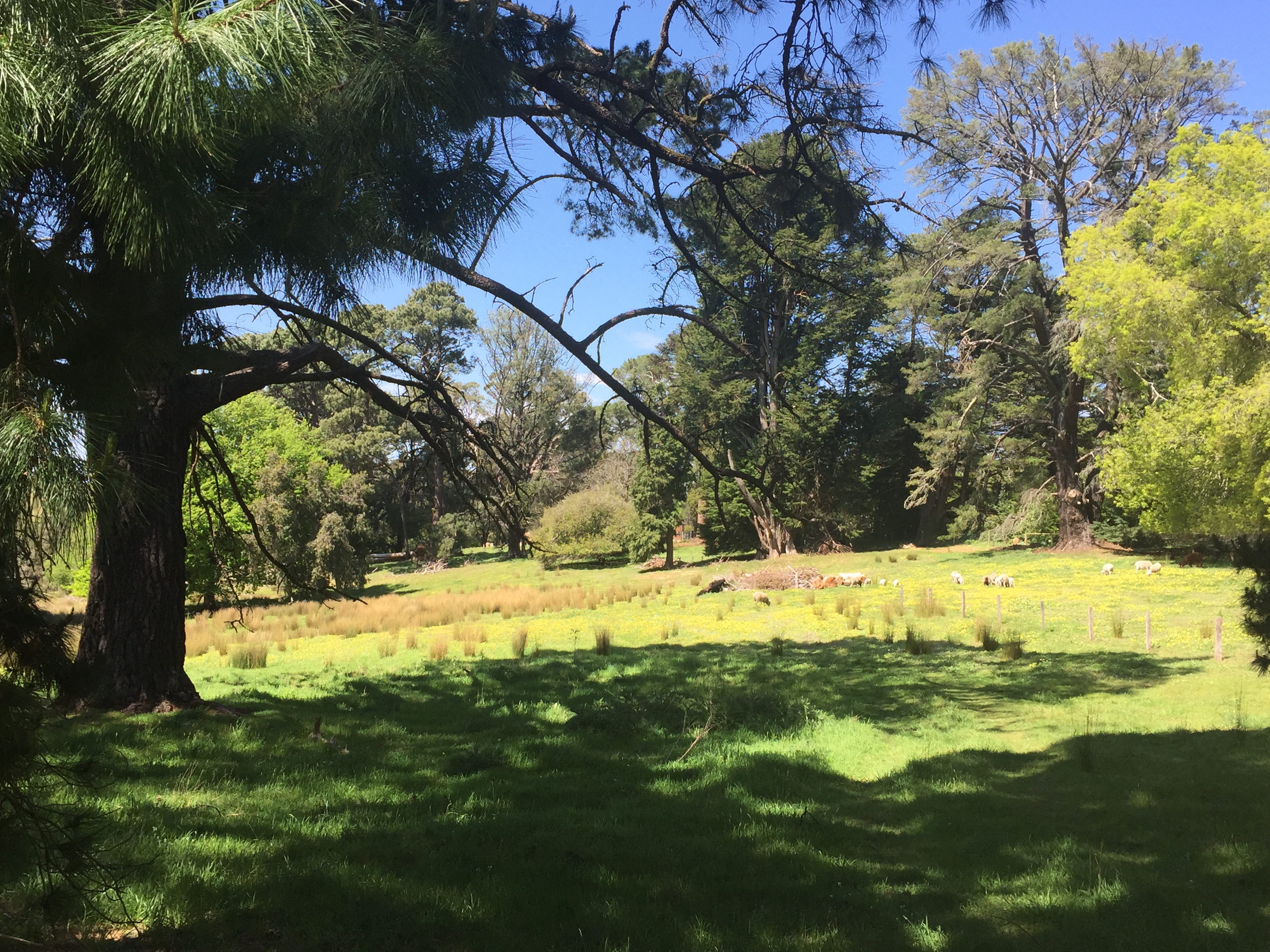
- Sunday before the Tour Down Under, there is the Ride Like Crazy! 100 km and this year was most enjoyable – no cramps! In 5 days time we ride from Echunga to Victor Harbor 100 km with thighs busting King of the Mountain 10 km from the finish. But the cool ocean of Horseshoe Bay is our reward!
The Bike!
New wheels, old rider!
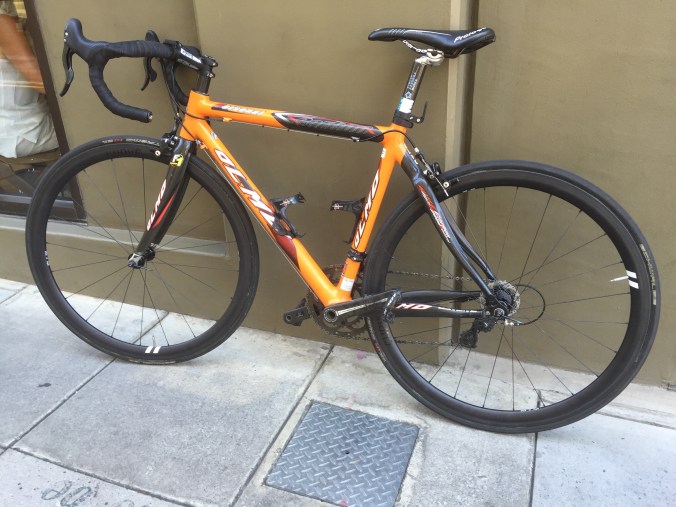
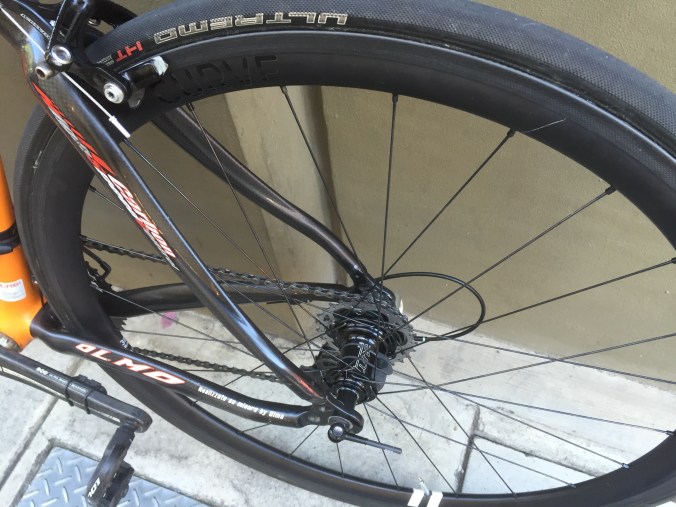
Well the OLMO is as new with CURVE carbon wheels and TUNE hubs. The trusty ZIP 303 were cracked and “bloody dangerous” according to my bike mechanic. So I discussed options with my Financial planner and as is my usual practice, ignored his advice and spent a few thousand dollars!
It goes like the wind and is a sibilant of adjectives: “silky smooth, stable, stiff, speedy and … SILENT”!
Carbon Neutral?
After I suspect 10 years, my faithful OLMO road bike began to make disconcerting noises which I had great difficulty in localising. Well intentioned friends and cycling buddies made helpful comments whilst others were downright rude suggesting that I should move from carbon to titanium. Eventually I dropped the bike into my favourite repair shop and Pete said he would fix it for me. A few days later I received an email telling me that the Zip 300 carbon wheels were cracked, the tubular tyres were at the point of falling off and he was fearful of the stability and said that I should not ride it at all until fixed. After much negotiation and again helpful and unhelpful comments from friends about what to do, I invested in a new set of carbon wheels made by”Curve” with “Tune” hubs.
I have now had to rise both up Norton summit and down again and another one across the usual Cycle track to Belair and then down the freeway. It goes like a rocket and is extremely stable even at speed on the descent down the freeway although I am by nature extremely conservative but I certainly felt reasonably safe.
I will not disclose the cost, It was substantial although well worth the investment and it is my only vice.


A Spring Sunday ride
The Joys of A Summer Ride
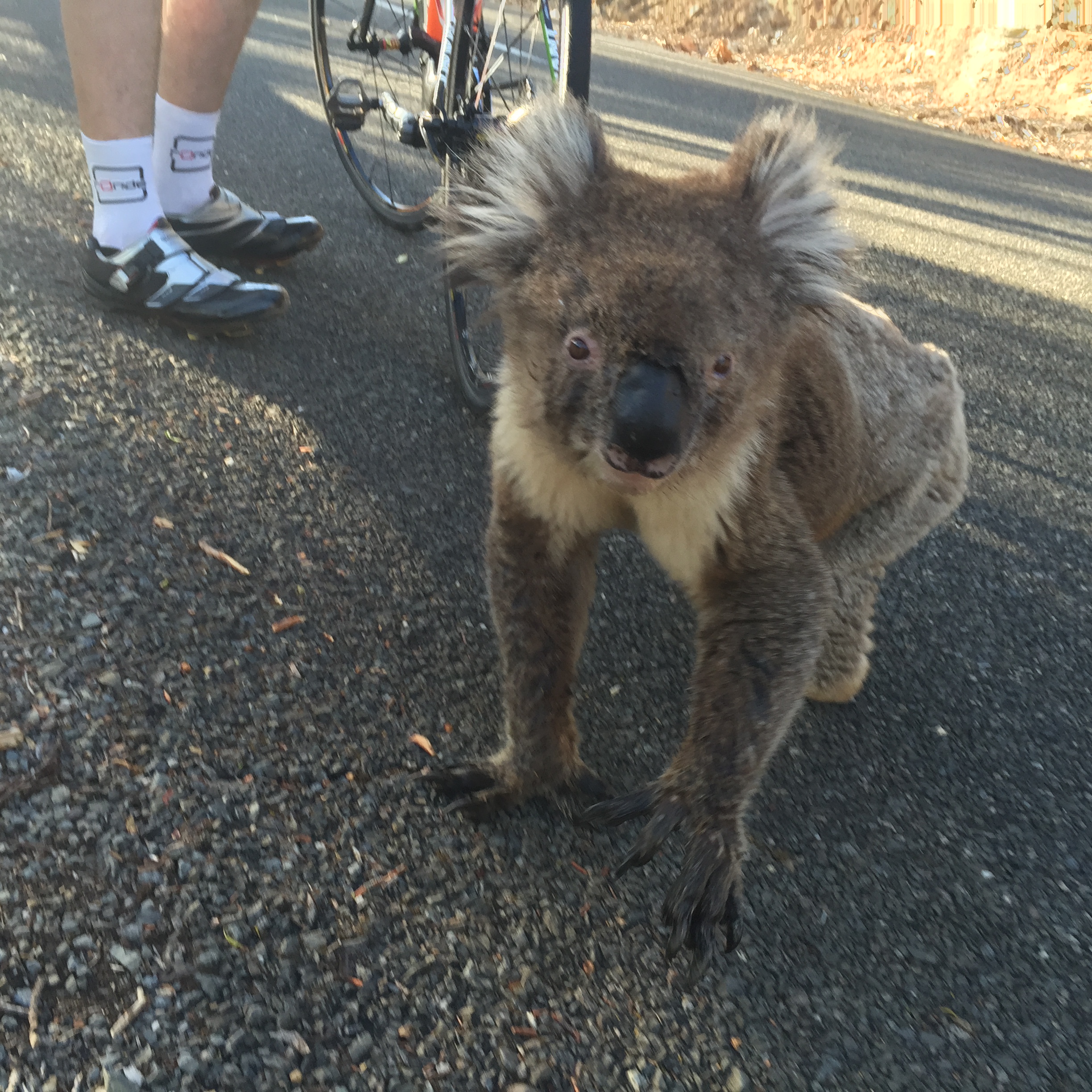
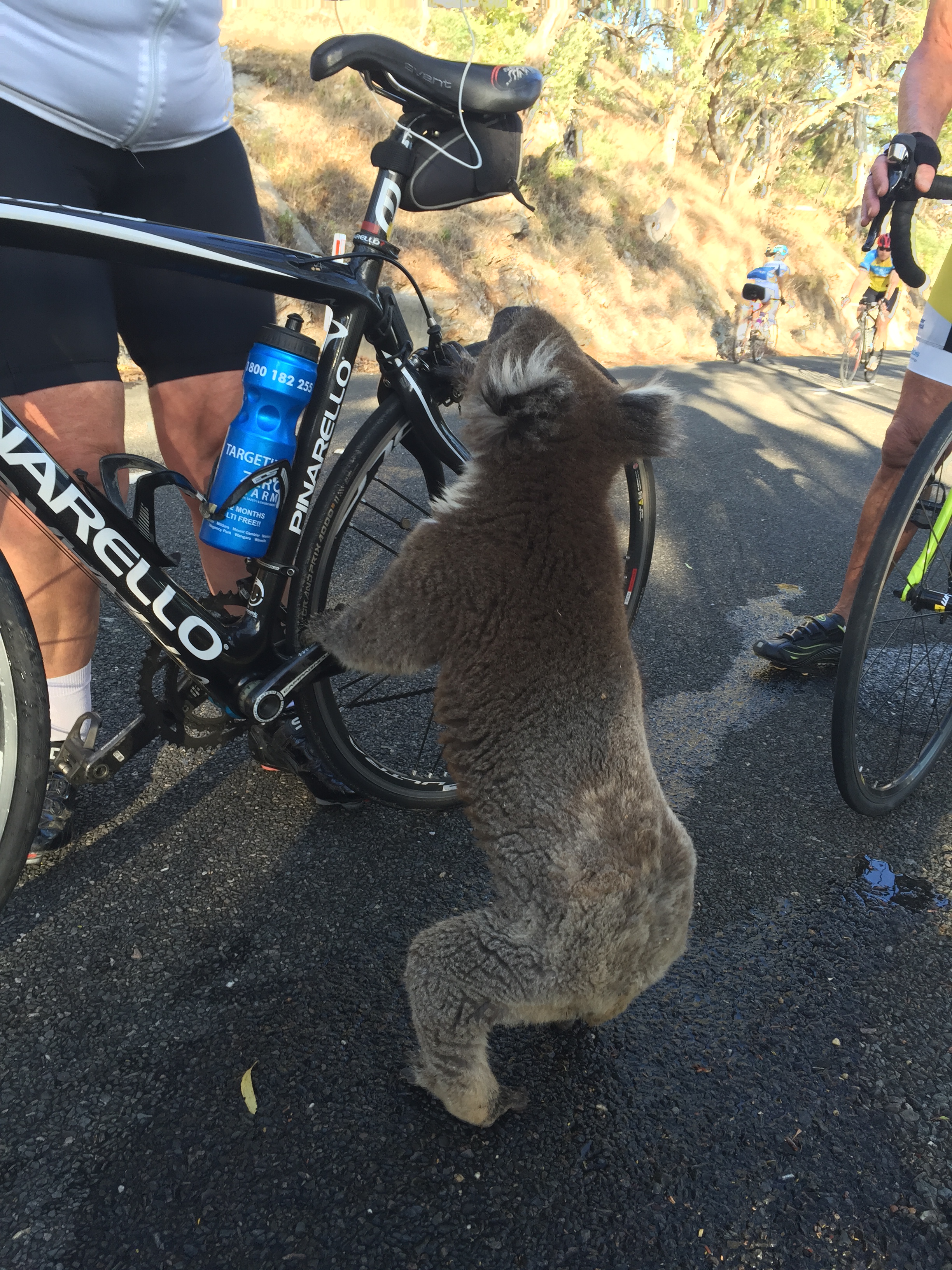
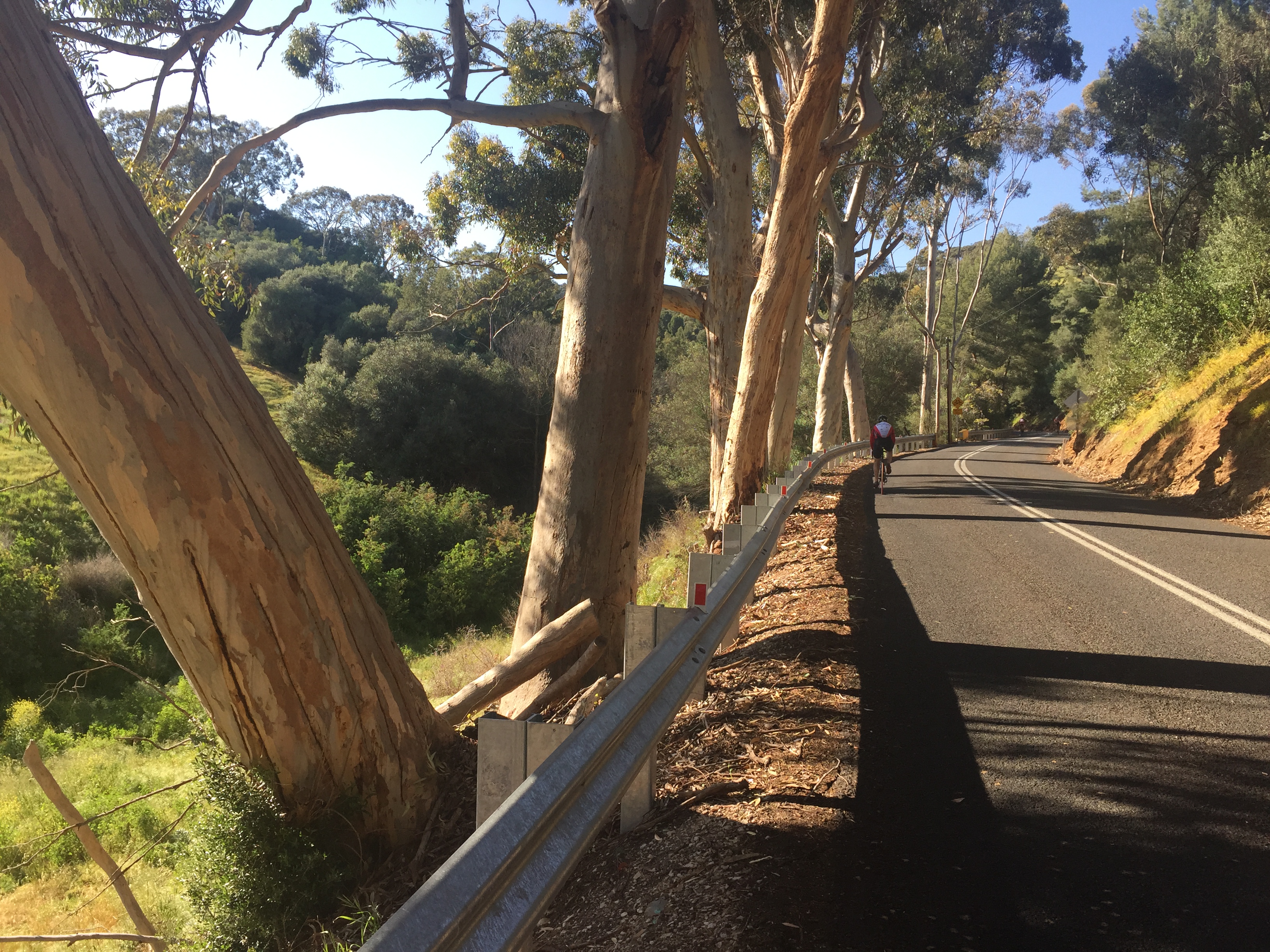
It has not been an unusually hot summer, whilst we have had the occasional daytime temperature exceeding 41°, certainly there have not been runs of several days as we did last year. My Saturday morning summer routine is to join the hundreds of cyclists as they pant and push their way up the old Norton Summit Road. This week on the way down we came across this remarkable sight. A young male koala sitting in the middle of the road
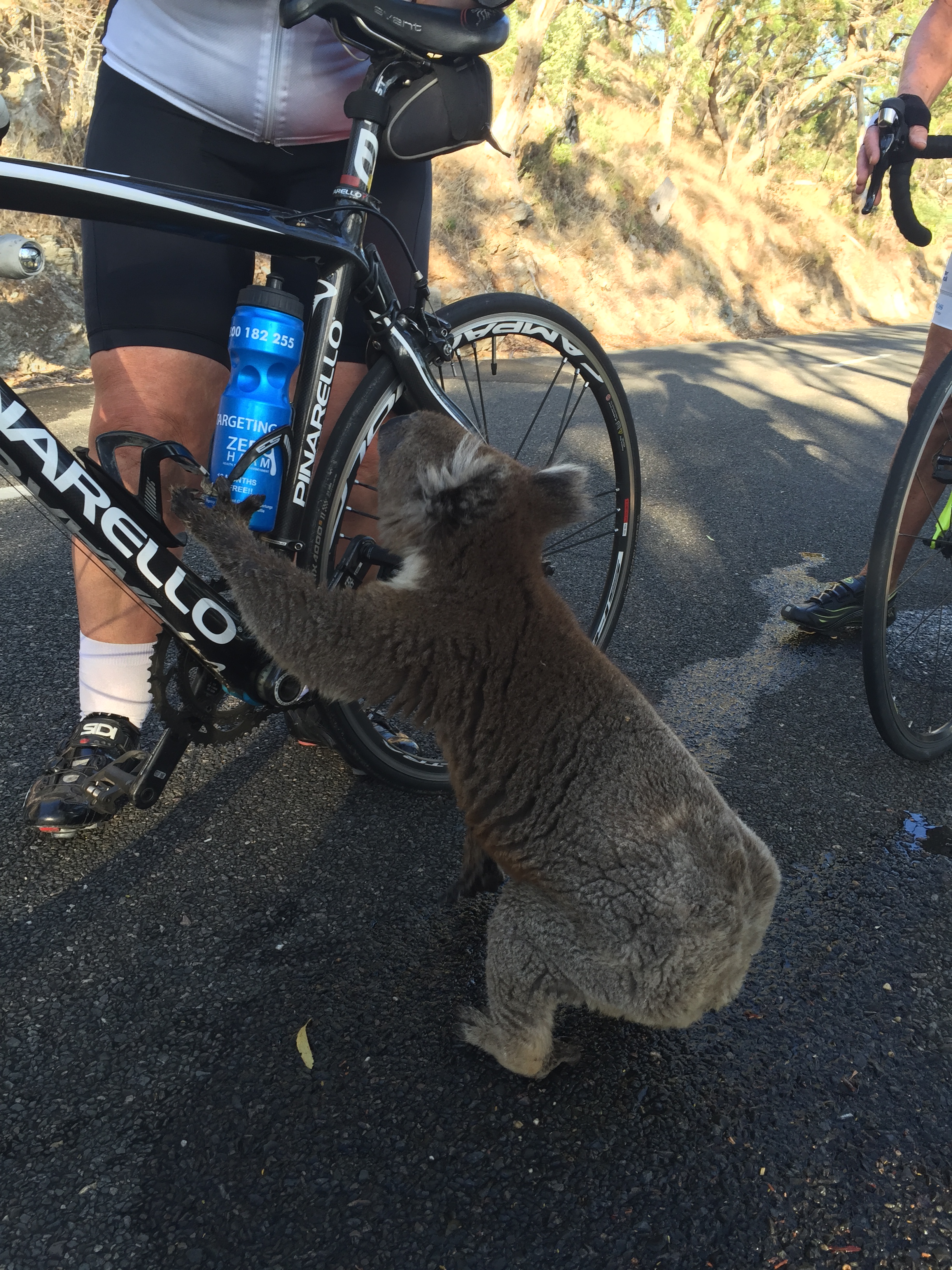
It did not even attempt to run away but was obviously severely dehydrated and indeed managed to consume several drinks bottles from the cyclists as they came down and stopped. I suspect the poor thing was sick in some way. I wondered whether koalas could suffer from diabetes? Anyway after consuming at least 10 or 12 L of water it waddled back into the hills and climbed the nearest gumtree! I have never seen this before and it almost appeared that the Koala knew exactly where the water was and would reach up for the drink containers on the bike.
One of the cyclists phoned the animal rescue unit as we were all of the opinion that it was not well! Eventually we all cycled back down and I headed off to the Norwood swimming pool to cool down before of course heading off to the mandatory coffee on the Parade.

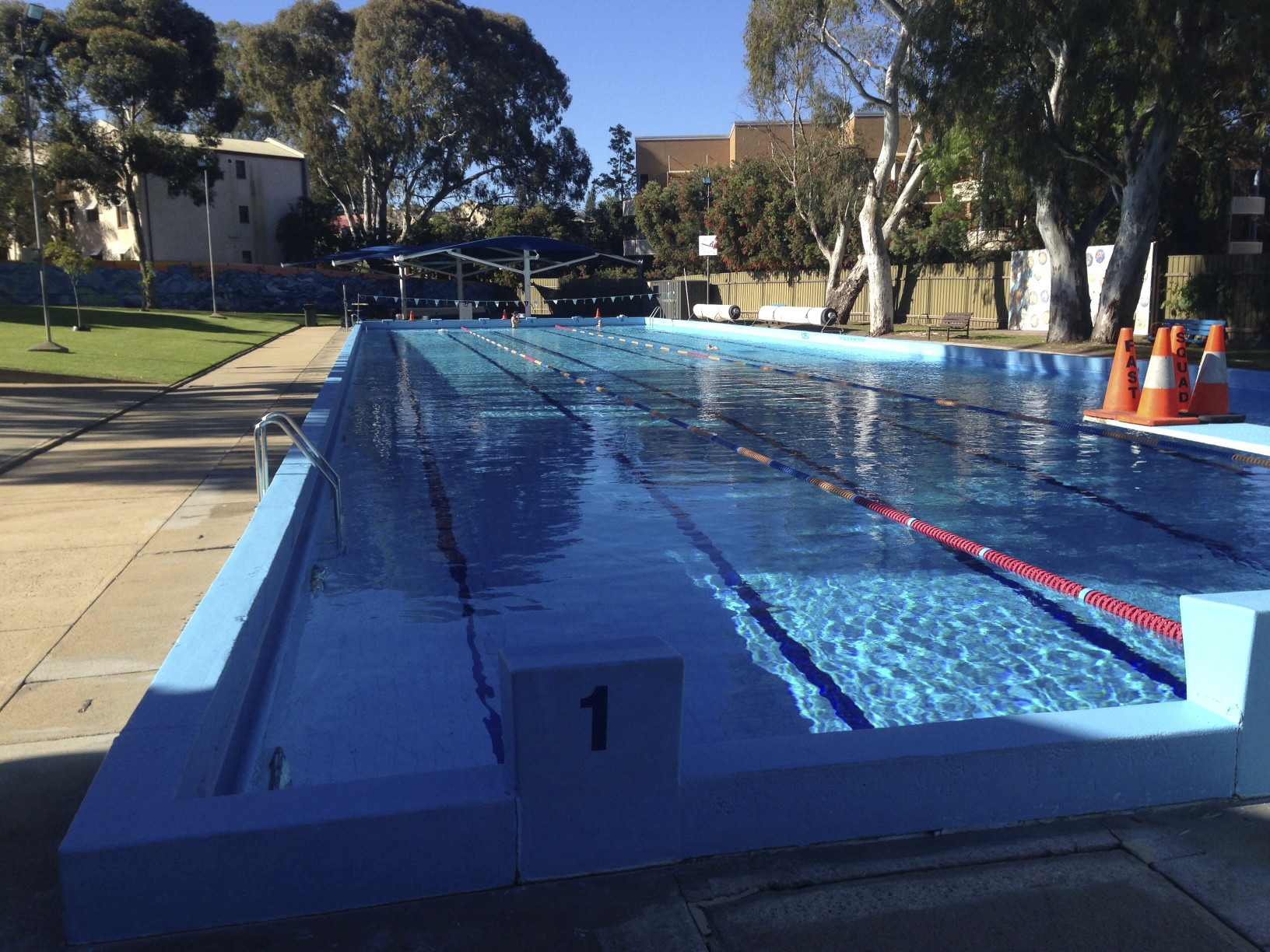
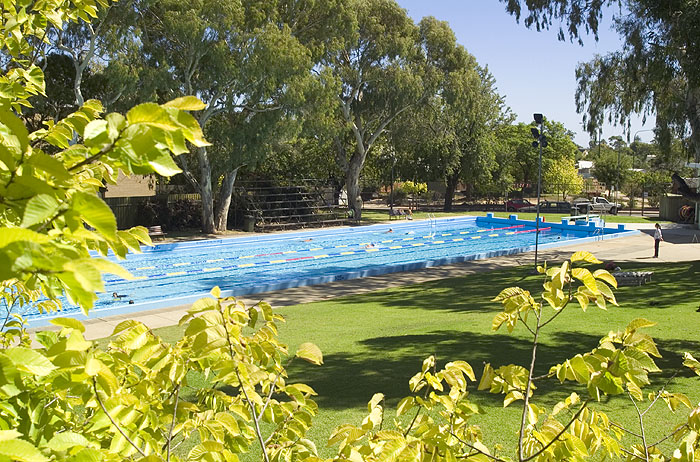
This is the OLDEST community swimming pool in South Australia, It is 55 yards long, not 50 metres. It celebrated its 50th anniversary about 5 years ago. The water is pristine.
Within the next three weeks I’m heading off to a couple of medical conferences the first in Budapest, “Controversies in Neurology”. Then I shall journey to the northern part of England and Scotland and the Lakes district’s where my cousin lives with his wife and spend a week with them. He has organised a bicycle for me! Then I will head down to London for another conference on epilepsy before returning home.
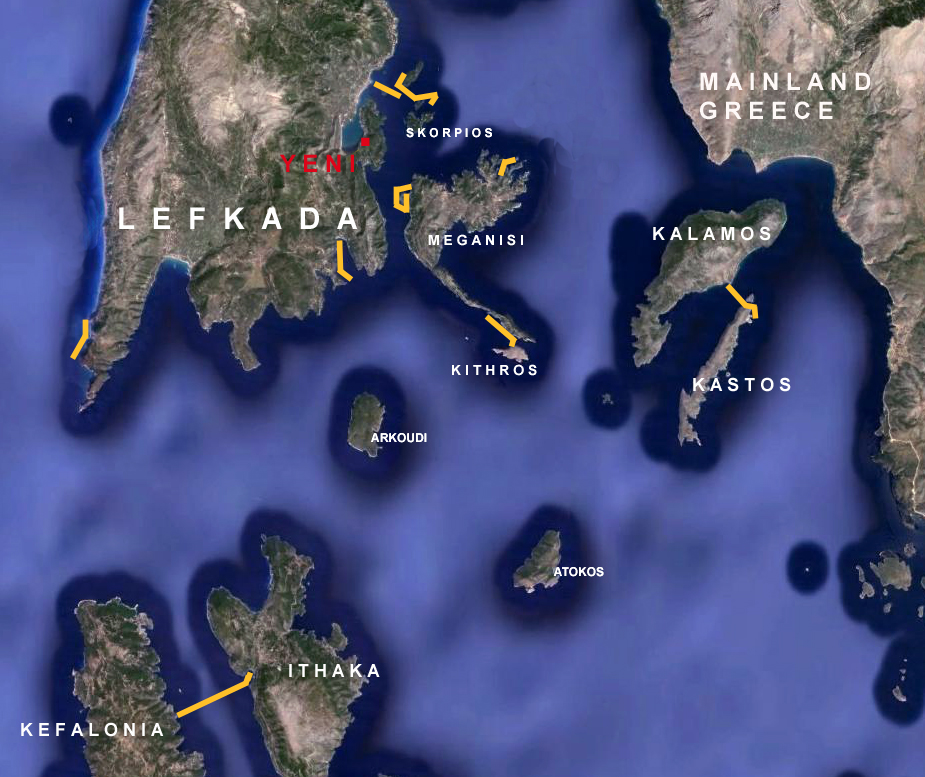
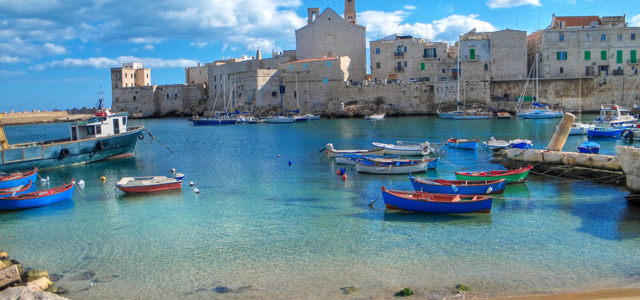
I have already planned a month off in September, I will head to Istanbul for a week then I am rather excited about the possibility of a swimming trek for eight days between the various Greek islands before heading down to the southern part of Italy and the town of LECCE about which I have become rather fascinated. and yes you have read correctly it will be a swimming trek and to confirm this a photo of the various swims around the Greek isles appears below. The yellow lines mark each individual swimming trek of about three or 4 km and we do TWO each day.
And as for Lecce, I was knew I had to visit when I watched a great Italian Movie as in this link
http://www.imdb.com/media/rm2691793920/tt1405810?ref_=ttmd_md_pv#
So.. any of my readers are keen to join me? Start your swim training and cycling today!
Spring in Adelaide
A month in Piedmont and the Cinque Terre reinforces the perception that I am blessed to live in Australia and specifically, Adelaide. I love travel and will continue whilst ever my body and money permit. I have alluded to the book “The Art of Travel” by Alain de Botton and I read it at the beginning of my 3 months trip in August 2012. It is insightful. Read it to help pass the tedious 12 hours as you jet to Europe via Dubai. At a very basic level the scenery that appeared before me on a bicycle in Piedmonte is equalled on my cycle trips in the Adelaide Hills.
Then of course at the start of the month of October the Norwood Outdoor Pool opens!

This is the OLDEST community swimming pool in South Australia, It is 55 yards long, not 50 metres. It celebrated its 50th anniversary about 5 years ago. The water is pristine.
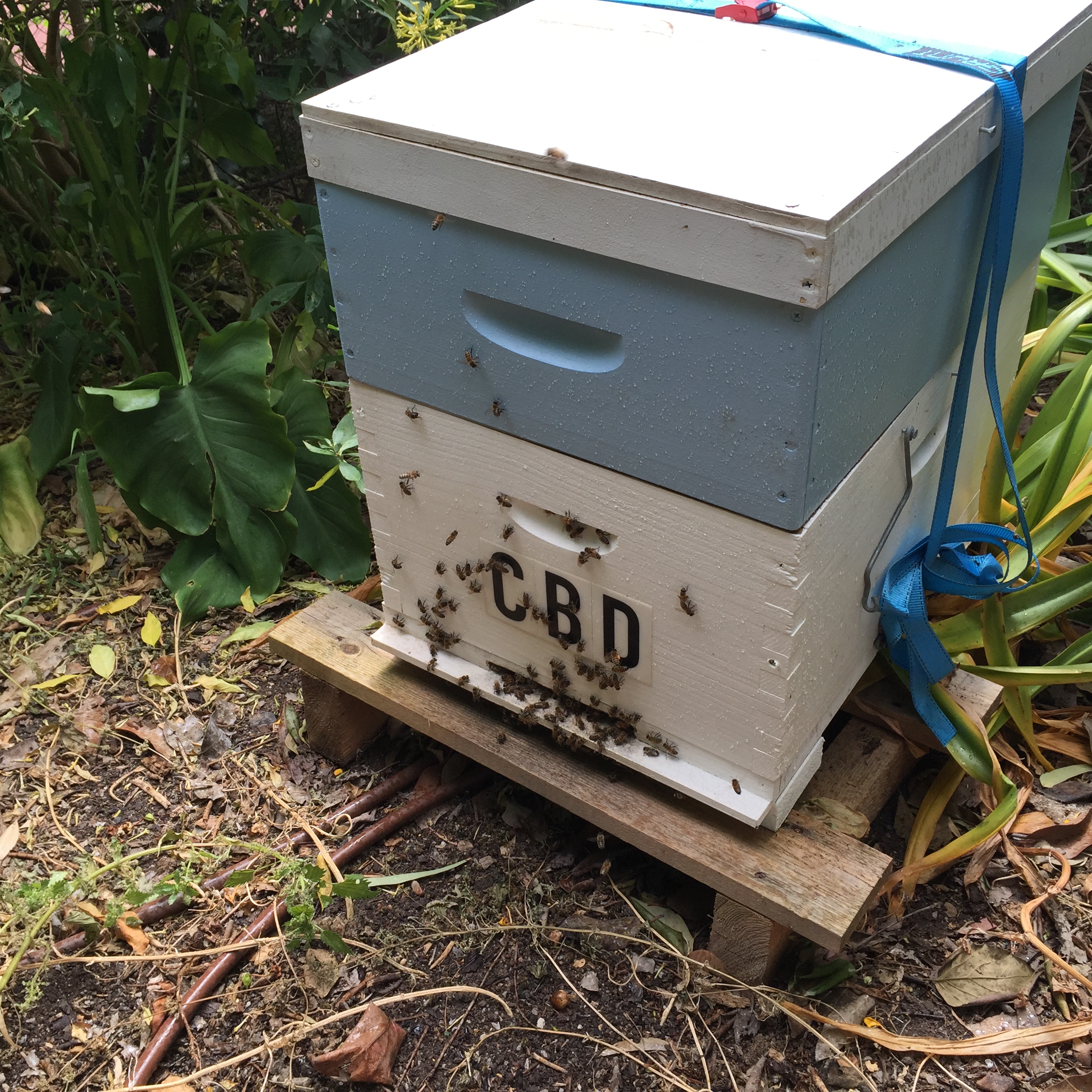
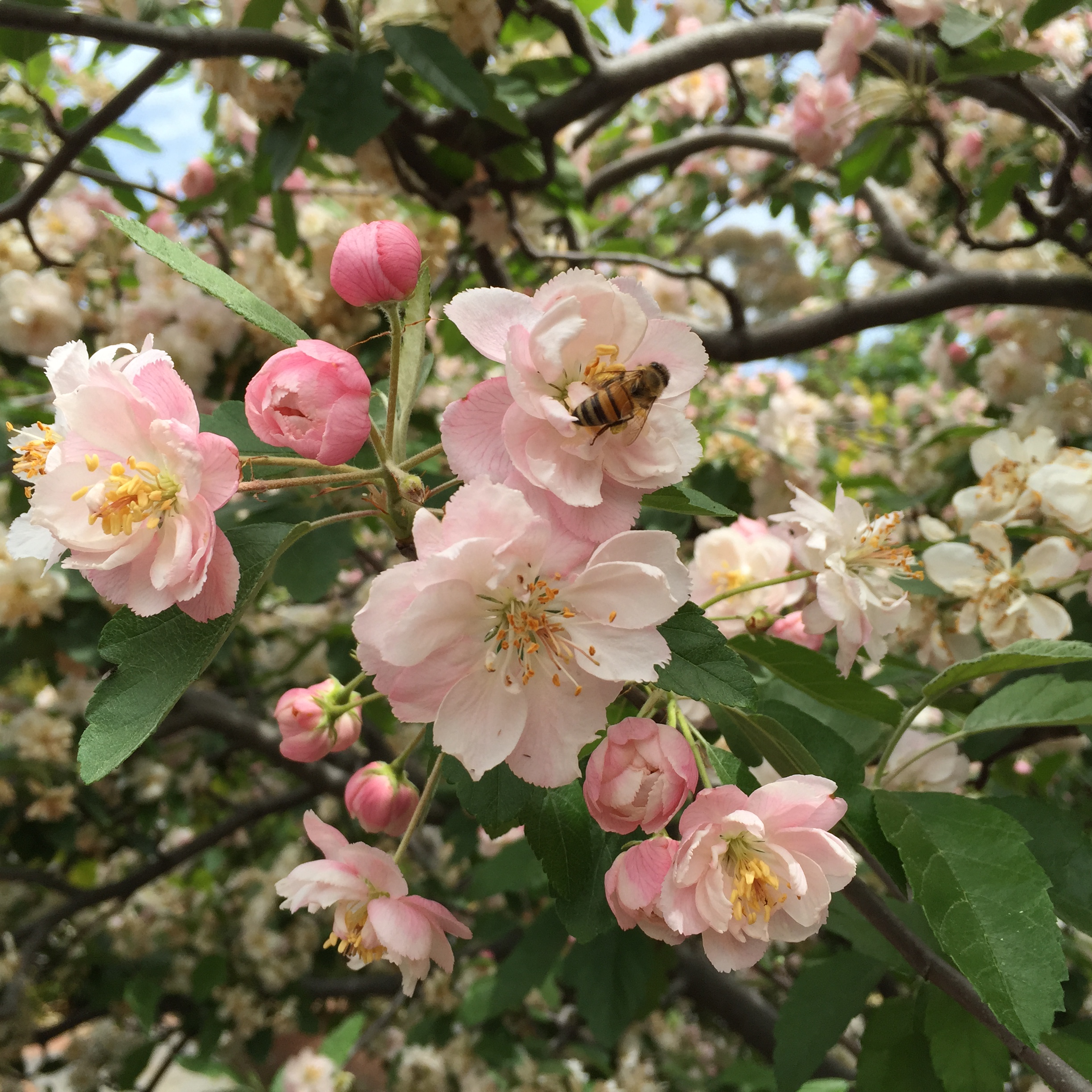
By Spring the Bees are busy and I have a hive in my garden!
The Crabapple at the front of the house is in bloom and an orgy of blossoms and bees!

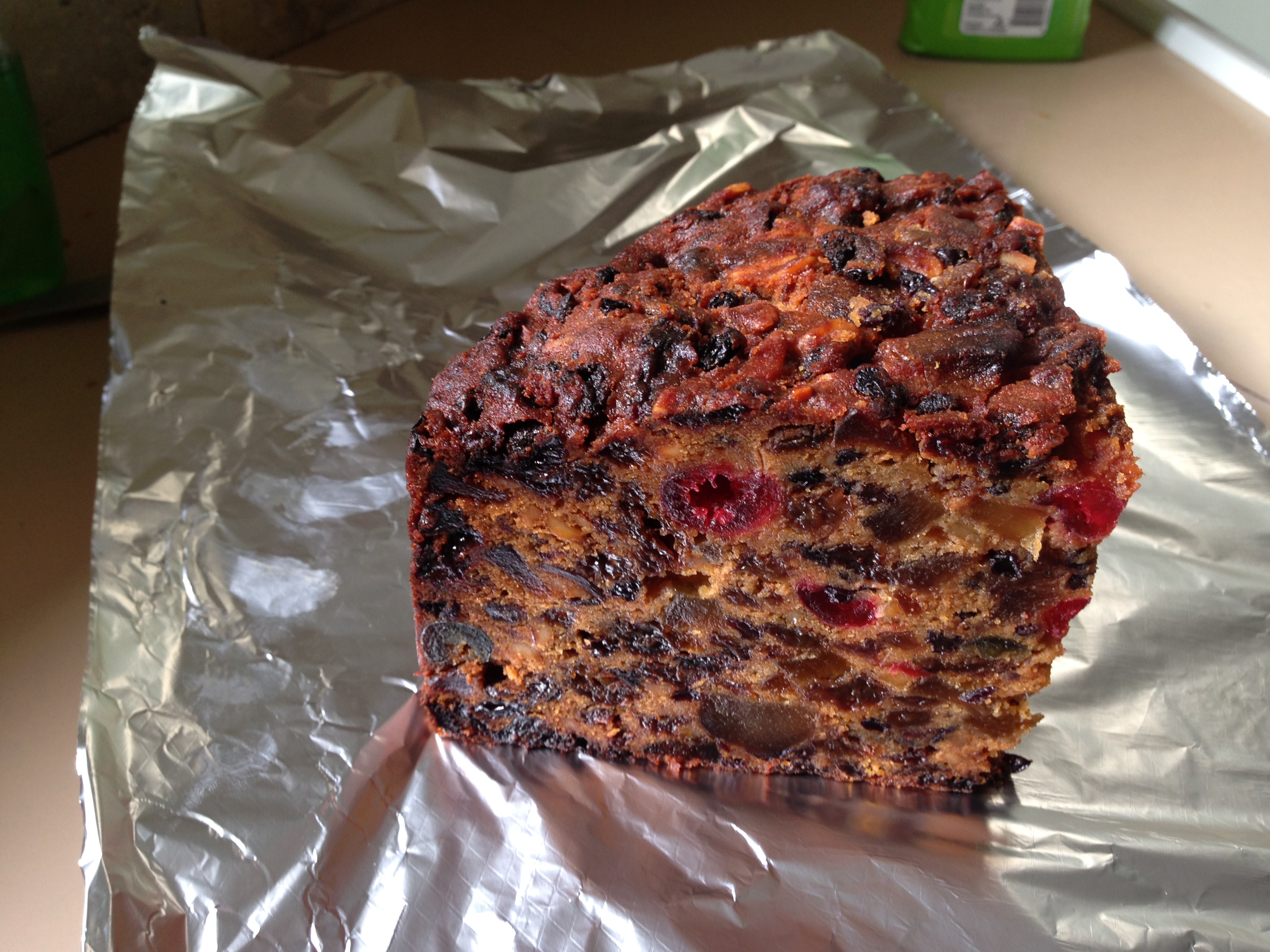
Then of course by November its time for me to soak my FRUIT for the Christmas Cake!
The express train to Milan
The fast express train to Milan leaves Santa Margherita at 13.35, first stop Genova half an hour later. The local train, all stops, leaves from the same platform 7 minutes later at 14:02 arriving in no less than 10 minutes at Comogli. We planned to train to Comogli, do a circuit bush walk and bus back to Santa Marherita. It was our first day of inclement weather. Rain had well and truely set in.
To further set the scene for the events that unfolded, I should explain it is a given that the Swiss train system runs with clockwork precision. It is apparent that all station clocks across Switzerland are synchronous. When the station clock at Basle shows the time as 13:45 and 47 seconds, it will be 13:45 and 47 seconds in Geneva. When a Swiss train is scheduled to leave at 13:45 and 47 seconds, that Swiss train will indeed start to move at 13:45 and 47 seconds precisely.
The Italian train system, as I learnt, today, runs like pasta – it bends in hot water. At precisely 14:02 the train pulls into Santa Margherita station. It is surprisingly full, so much so that we are forced to stand in the aisle along with several other elderly Italians. We can cope as the next stop, Comogli is all of 12 minutes away. The train picks up speed and enters a long tunnel, we are in darkness for several minutes, then suddenly travelling at 100km/hr we shoot out the tunnel, to a vast expanse of the Ligurian sea on our left and the small station of Comogli on our right. The rush of the speeding train creates a violent vortex and like a scene from the Wizard of Oz, several seagulls, thousands of cigarette butts, and a baby’s pram on the Comogli platform, are sucked into a spiralling tornado. We had failed to realise that the intercity express to Milan was running exactly 27 minutes late. It sped along, seemingly out of control, to finally run of out puff and stop at Genova,the capital of the Ligurian provence. We alighted, considered our options, that as were here, set off to explore the city. It was worthwhile, despite the inclement weather. More aware of the vagaries of the Italian rail system, we more carefully researched the return journey.
Had a great final dinner at the Ristorante Pizzeria dal Baffo. Their pasta is made on the premises. The spinach ravioli in a walnut cream sauce then steamed fresh fish with mussels, pippins, prawns, octopus and calamari in a tomato sauce. Both sauces so spectacularly tasty that they begged to be mopped up with crusty bread. We shared a warm apple pie with vanilla gelato. Then, as the night was cool and it was still twilight, contentedly satiated, we sauntered down Via Garibaldi. Which reminds me, if you are bored at any time, search for “via Garibaldi” in Google Maps. The result will astound you – hundreds of thousands of such streets in every village, town and city of Italy and then some!

The view over Santa Margherita Harbour early morning

A couple of pictures of The San Giacomo di Corte Church part of the Villa Durazzo Centurione on a hill overlooking Santa Margherita

A few pictures of our unexpected day trip to Genova on a humid wet day! Street scenes and the inevitable cathedral.
The Ligurian Coast of Italy
After the week of cycling, I travelled to the town of Santa Margherita, in the smallest provence of Italy, namely Liguria, capital Genova. It’s a crescent shaped ribbon of land that has the Alps of Piedmontese to the north, falling down to the Ligurian Sea, part of the Mediterranean. The tourist pamphlet for Santa Margherita claims the area was founded in 262 BC. It further states “It has always been a fisher and sailor village, well known for handicrafts: laces made on lace-pillows and ropery”. I did a quick retake! Yes that’s “ropery”. As to sailors and lace pillows, nothing like a bit of petit-pointe to pass the tedious months sailing across the great oceans. Indeed some of the best cross stitching is attributed to Italian sailors in the 18th century
The most famous destination of this so called Italian Riviera is Portofino. It’s the iconic, picture post card Italian fishing village, now an expensive tourist magnet. The other attraction is the Cinque Terre, again five previous fishing villages that face the sea and now sustained by tourism. I undertook the obligatory day to meander around Portofino, mesmerised by the melanin enhanced middle aged women ( alliteration to simply mean that they were sunburnt unnaturally and uniformly all over). Then it was time to escape and walk over the promontory from Santa Margherita to the medieval monastery of San Fruttuoso. A strenuous climb equal to any of the cycle days. This part of the steep cliffs and hidden alcoves is a national park. The Abbey, almost 1200 years old is fascinating, but does not escape the Italian beach culture. A delightful day.
The Ligurian Coastal beaches are to put it bluntly, un-enticing. There is no sand as we in Australia know, but rather coarse stones and pebbles, that make getting to the surf a form of water torture. The sea is a grey green colour and pleasantly warm. There the attraction ends. There is the feeling that the water, at least in the inlets and alcoves which are inhabited, is not exactly pure or crystal clear. A thin oily film of almost certainly disesoleum, is broken by feathers, plastic and the discarded containers of a disposable society. Once clear of the populated bays and inlets, the sea returns to a more enticing and characteristic clean crystal blue.
There is hardly a part of these stone beaches that are not invaded by sun worshipping Italians. Most of them pay upwards of 12 to 15 euro to sit on row upon row of beach chairs and umbrellas, to hobble to the waters edge once or twice a day, then return and light up a cigarette. Even the scavenging sea gulls exhibit signs of nicotine addiction, from pecking at the butts. Cigarettes I mean.
In general there is much less obesity visible in the general population and the Italians do dress with flair and good taste. This is despite the wine, pasta and bread, my theory is that they do walk around a lot more and of course, smoking is a great way to keep weight down.
After the day walk to San Fruttuoso, the next day I took a ferry trip to the Cinque Terre, a rather choppy swell prevented landing at the smaller towns, so that we were only able to disembark at the largest village of Montarossa. My rather jaundiced and queezy opinion on the region and villages is that they are all becoming like Portofino. One arrives, admires the brightly painted buildings in ochre, yellows and tan brown, then joins a slow moving mass of visitors through narrow streets that were once charming, but now comprise outdoor eating, gelato parlours that all boast “artisan” or “home-made”, expensive clothing outlets and souvenir shops.
Our first night here I dined at one of the most renowned restaurants. This was not intentional, it was just around the corner from the hotel. The next night a great seafood establishment: seafood risotto and then last night a “local” cafe recommended by the girl at the tourist office. A large pork chop and creamy mash potatoes.
Finally as this is the last week, I travel to Milan tomorrow, I am in the process of discarding unwanted clothes and washing a couple of T shirts. I have clean socks and one pair of underpants!

Portofino – a postcard scene recognised the world over

Sunday service finishes the Cathedral of Santa Margherita.

The cliff top walk from Santa Magherita in the National Park
Final thoughts – cycling in Italy
In terms of my European cycle adventures to date, Italy does not have the cycling infrastructure of the more developed members of the European Community, for example Germany, Switzerland, Austria, France and even the Czech Republic. My only Spanish adventure was the Camino and that was mostly a dedicated trail at times challenging even on a mountain bike. So it’s rather unique as a cycle route and I can’t compare it.
In Piedmontese the route was on minor roads, occasional busy roads and at times gravel roads or tracks. The smooth well maintained sealed dedicated cycle roads of the countries mentioned above, do not exist in this part of Italy. What this meant was that no matter how narrow, bumpy or seemingly impassable the track presented, there would appear at the most inconvenient times some form of motor vehicle. It could be a Fiat or a spluttering farmer’s truck, or tractor. Such confrontations were often potentially more hazardous than on those roads where cars were supposed to be!
These minor roads in Italy were for the most part poorly maintained with potholes and uneven surfaces especially on the shoulders. Be that as it may, Italian drivers for the most part are cycle aware and hence considerate. The poor quality road surface combined with the more common smaller cars, dictated that the average speed was no more than 60 to 80 km/hour. Drivers faced with a cyclist travelling in the same direction would obviously slow down, give you a wide berth, indeed, if possible moving across into the opposite lane! If by chance the situation arose when added to the mix was an oncoming vehicle, rather than in typical Australian reaction, accelerating to try and overtake, the car would actually slow down considerably to allow the oncoming car to pass safely, then pull out. Most reassuring.
In retrospect, choosing the month of August to travel in Europe has the benefit of summer and more enjoyable weather. The down side is that it is the peak holiday season, the equivalent of our end of year December/January holidays. Consequently many restaurants especially are closed as well as other stores. Add this to the mix of the regular siesta from noon to 4 pm and Italy grinds to a stuporous state. These comments I suspect apply mainly to the smaller regional towns and villages rather than the state capitals.
Should one pass through a village before noon, chances are there will be a local market in the piazza. These do not differ in anyway from the local markets in Australia in that there is an abundance of extremely cheap, poorly made and what can only be characterised as tacky, merchandise. Over represented is clothing, underwear, especially bras, and lingerie as well as shoes. However the food market is certainly not matched in Australia – due in part I suspect to our strict occupational health and hygiene regulations. There is a wonderful choice of fresh fruit and vegetables, stone fruit at this time, and exotic vegetables. All of this is crowned by the ubiquitous tomato. Tomatoes of all shapes and sizes, all beautifully naturally ripened on the vine and tasting superb. To even market an anaemic tasteless tomato is anathema to every Italian.
The next stage of the trip is train the the Ligure Coast and the Cinque Terre.
Asti to Casale Monferrato to Alessandra
The cycle notes state that the distance will be 55km with total ascent of 700m. The climbs thankfully were indeed more gentle and therefore enjoyable. We struck the usual irritation at cycling through ghost towns just when we all needed a coffee. We pushed on to be rewarded by a road side cafe that created reasonable coffee and some adventurous tarts! We had lunch in a village square with bread, fruit cheese and cold meats. A fountain provided potable drinking water.
The hotel Candiani at Casale Monferrato was a great place for our penultimate night. Again we discovered a good restaurant, after much searching. Many of the recommended establishments on Trip Advisor or Google Maps being either shut for summer holidays or seemingly permanently closed down. The cafe opened at 18:30 and we were on the door step at 18:31. Again we asked for typical local food and wine. I noticed that as well, there was kangaroo on the menu!
The last day was, I am sure, designed to send us away happy as it was basically a flat ride on relatively quiet back roads returning to Alessandra. Once we had left the rolling hills and followed the River Po, the main crops changed to vast fields of maize and poplar plantations! The poplar wood I am told is to make match sticks. Given my perception that the only Italians who don’t smoke, were born with phocomelia, I can understand that the demand for Redheads, must be astronomical. Indeed forget about investing in Australian macadamia nuts, shift your hard earned investments into Italian hazelnut forests or poplar plantations, where indeed one may literally and figuratively see your cash go up in smoke.
We again had a picnic lunch in a delightful piazza in the village of Castelletto Monferrato. Then a slightly more hazardous cycle back into our start point a week ago at Alessandra. I shall practice the Recorder again. I have attempted to be religious in my adherence to setting aside practice time. I have to confess that on a few days I have lapsed.

The Cathedral of Saint Mary of the Assumption – exterior at Asti

The Cathedral of Saint Mary of the Assumption – interior at Asti